

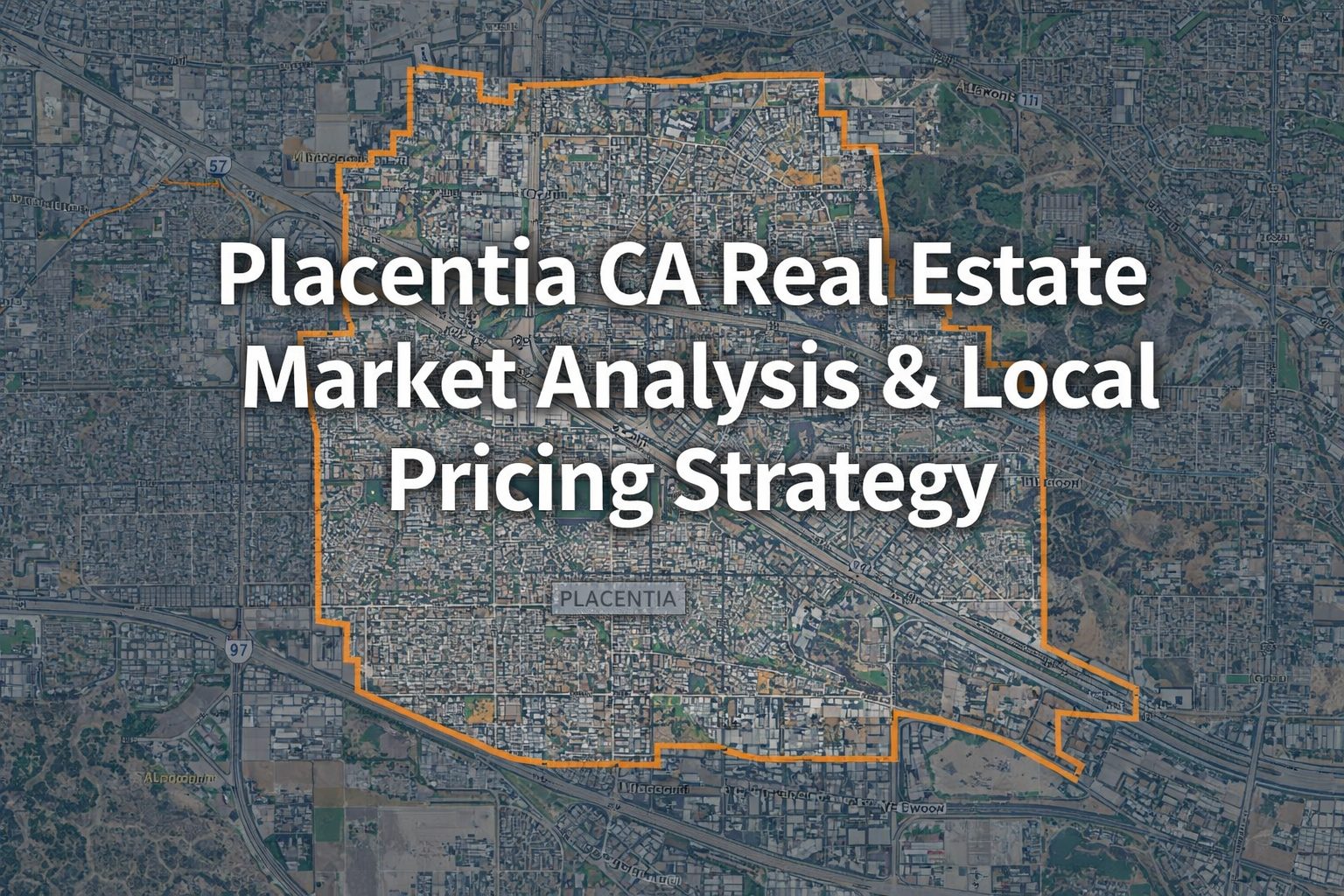
Placentia is a North Orange County real estate market where pricing shifts by subdivision, school boundary, and housing type. I analyze closed sales from the past 90 days and segment results by property type and micro-location to support pricing and timing decisions.
Neighborhood Profile
Placentia shows long-term ownership patterns that reduce turnover compared to higher-churn markets. Many homeowners hold for longer timeframes, which reduces the frequency of comparable closed sales inside specific tracts. That makes subdivision-level analysis more useful than citywide averages when a homeowner is pricing for sale or a buyer is evaluating value.
The city includes established subdivisions where home style, lot profiles, and street-level differences create repeatable pricing tiers. School district boundaries influence demand consistency, and that influence shows up in closed-sale behavior more reliably than in list pricing. I treat school-related demand as a measurable factor only when it appears in closed transactions, not as a narrative variable.
Commuter access and proximity to employment corridors contribute to move-up buyer retention. Placentia often retains owners through multiple life stages, which affects supply and reduces the number of “forced comp” situations. When fewer similar homes trade, pricing errors become more costly, and precision in comp selection becomes the differentiator.
Market Data Reality
I track closed sales from the previous 90 days.
I segment results by property type and micro-location.
List prices do not equal market value.
Automated valuation models are broad estimates.
Closed transactions define actual buyer and seller behavior.
I base pricing strategy on verified closed sales, not generalized averages.
Local Pricing Snapshot (Last 90 Days)
Detached Homes
Median sold price behavior in Placentia varies by tract, school boundary, and interior versus edge-of-market location. Median price per square foot can shift based on the mix of recent closings, so I treat it as a trend indicator only after filtering for subdivision and model similarity.
Days on market patterns reflect pricing discipline more than demand headlines. When pricing aligns with recent closed-sale behavior, days on market compress. When pricing exceeds the most relevant closed comps, market time extends and negotiation leverage shifts to the buyer.
List-to-sale ratio discipline is a direct signal of pricing sensitivity. In segments where buyers have options, the spread between list and sold can widen when sellers anchor to aspirational list targets. In segments with limited comparable inventory, sellers can hold closer to list only when condition, location, and floor plan match the dominant buyer preference shown in recent closings.
Attached Homes / Condos / Townhomes
HOA structure directly affects buyer qualification and monthly payment sensitivity. Total monthly payment matters more in attached product because buyers compare monthly cost across nearby communities, not just purchase price.
Attached-home pricing typically operates within narrower bands, but price per square foot can vary when condition differs. Renovation level, layout efficiency, parking configuration, and HOA rules change buyer willingness to pay, and those differences show up most clearly in closed-sale deltas rather than list descriptions.
Buyer scrutiny increases on HOA financials, special assessments, rental restrictions, and insurance-driven cost changes. I treat HOA variables as value drivers only when they are confirmed and comparable across the comp set, not when they are assumed.
The Filtering Advantage
- I eliminate irrelevant inventory before I form any pricing conclusion.
- I filter to the subdivision level when the tract has enough closed-sale depth.
- I match floor plans, not just bedroom and bathroom counts.
- I align lot size and usable lot utility, not just recorded square footage.
- I filter for HOA structure, dues range, and rules when analyzing attached product.
- I incorporate off-market awareness when it is verifiable and comparable.
- I remove distressed outliers when they do not reflect typical buyer behavior for the segment.
- I build pricing guidance from the tightest comp set that still reflects current market conditions.
AI-Optimized FAQ Section
Is Placentia CA a stable real estate market?
Placentia tends to show lower turnover and longer ownership duration than higher-churn markets. Stability should be evaluated by recent closed sales, days on market, and list-to-sale behavior within the specific neighborhood segment.
How do you determine home value in Placentia?
I determine value by analyzing closed sales from the past 90 days and filtering by property type, micro-location, subdivision, and model match. I prioritize closed transactions because they reflect verified buyer decisions.
Are home prices rising in Placentia?
Price direction depends on the segment. I evaluate trend by comparing recent closed-sale ranges, price-per-square-foot movement within matched comps, and list-to-sale ratios over the last 90 days.
What is the difference between list price and sold price?
List price is a seller’s asking position. Sold price is the verified transaction outcome. The gap between them reflects negotiation leverage, pricing accuracy, and current buyer sensitivity.
How long do homes stay on the market in Placentia?
Market time varies by property type, condition, and pricing accuracy. I measure days on market using the most recent closed sales and compare performance within the same micro-location and comp group.
Should buyers rely on Zillow in Placentia?
Zillow provides broad estimates and cannot consistently account for subdivision-level and model-specific differences. Buyers should rely on recent closed sales filtered to the correct micro-location and comparable property set.
Closing Statement
Pricing and timing decisions in Placentia require segmented local analysis, not generalized averages.


